School
A child with hearing loss in a mainstream school: seating, devices and what the teacher can change
How to support a child with hearing loss in school in India: seating, daily hearing aid checks, captions, sign language, exam provisions and the teacher's role.

In this post
- 01What does a child with hearing loss need from a mainstream school?
- 02Who should lead the plan: the audiologist, the teacher of the deaf or the school?
- 03What can the class teacher change?
- 04How should hearing aids and cochlear implant processors be checked at school?
- 05Indian Sign Language, speech or both: what should the school know?
- 06What exam provisions can a child with hearing loss get?
- 07How do we protect friendships and a sense of identity?
- 08How a shadow teacher or special educator helps
A child with hearing loss in school can do well in a mainstream class when three things are in place: they can see the teacher's face, their hearing aid or implant is working, and important instructions reach them in writing as well as aloud. Most of the changes cost the school very little. This guide explains who should lead the plan, what the class teacher can change, how to check devices each day, where Indian Sign Language fits, what the boards offer in exams, and how to protect friendships in a class of forty.
What does a child with hearing loss need from a mainstream school?
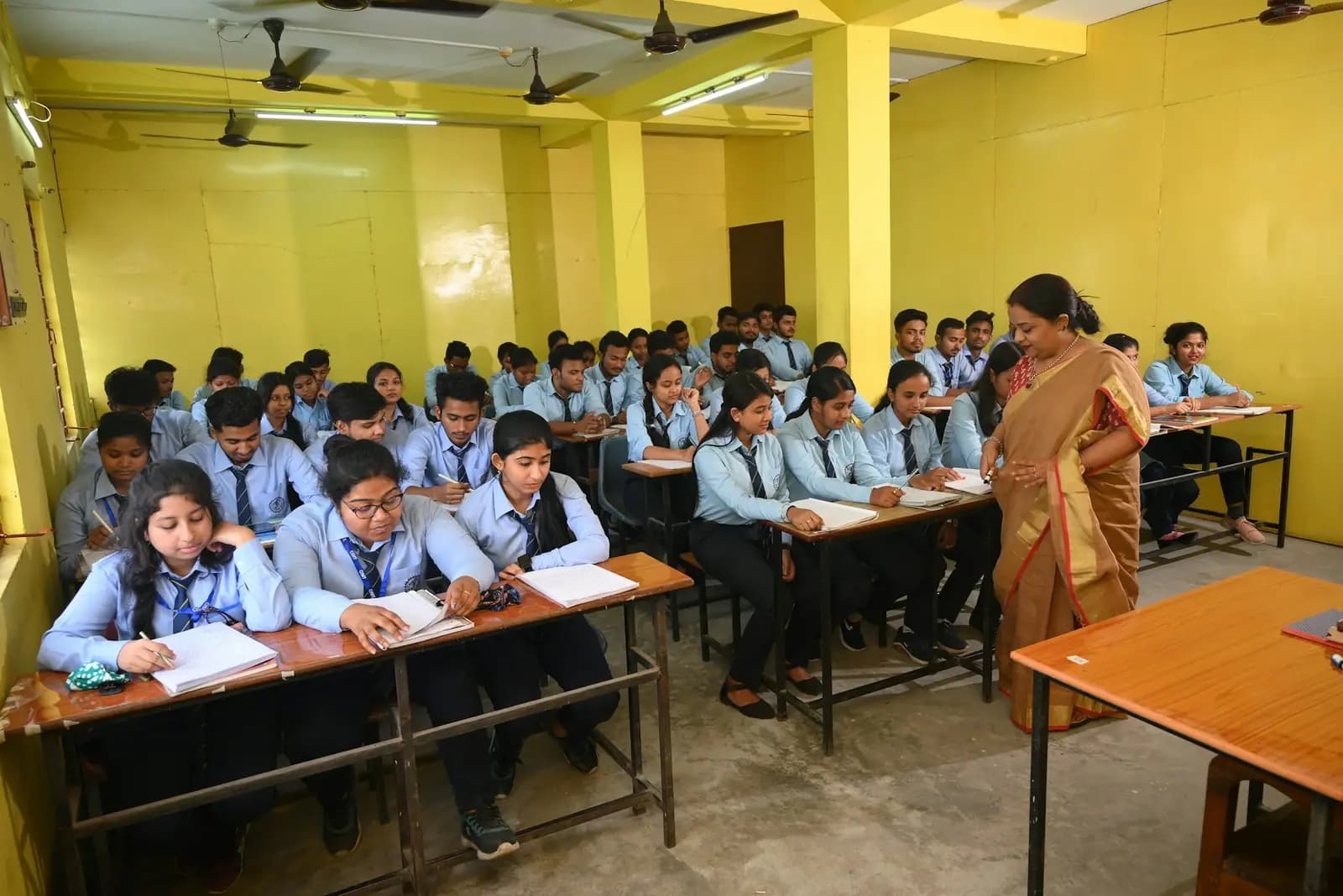
Hearing loss ranges from mild to profound, and two children with the same audiogram can manage very differently in class. Some children hear most speech with hearing aids in a quiet room and lose much of it in a noisy one. Others use a cochlear implant, and some rely mainly on Indian Sign Language. What they share is that a typical Indian classroom works against them: thirty-five to forty-five children, ceiling fans, traffic outside open windows, a teacher who talks while writing on the board, and answers called out from every corner.
Listening through that takes effort. Many children with hearing loss are tired by the last periods, not because they are less able but because they have spent the day piecing speech together from sound, lip patterns and context. When a child seems dreamy, slow to start or 'selective' in what they hear, the first question should be whether the message reached them at all.
The law is on the family's side. At the time of writing (September 2026), hearing impairment, covering both 'deaf' and 'hard of hearing', is one of the specified disabilities in the Schedule of the RPwD Act, 2016. Section 16 asks funded and recognised schools to provide reasonable accommodation and to teach deaf children in the most appropriate languages, modes and means of communication. What the RPwD Act says about education sets out those duties in full.
Who should lead the plan: the audiologist, the teacher of the deaf or the school?
The clinical plan belongs to the audiologist, working with the child's ENT doctor. They fit and programme the devices, test hearing over time, and can say what the child is likely to hear in a classroom and at what distance. A special educator trained in hearing impairment, often called a teacher of the deaf, turns that into a teaching plan: language targets, vocabulary to pre-teach before a new chapter, and how the child should be taught to read and write. The Rehabilitation Council of India runs standard training programmes in hearing impairment, so ask to see the educator's qualification and registration.
The school then carries the plan through the day. The class teacher makes the classroom changes; the school's special educator or a shadow teacher in the classroom checks that instructions have landed, pre-teaches new words and keeps a record of what the child missed. If the child also sees a speech-language pathologist, their targets belong in the same plan. Special educator or therapist: who does what explains how these roles fit together.
Ask for one written plan that everyone signs up to, reviewed each term. A short profile in the school diary, with a photograph of the devices and the three things that help most, gets the plan to subject teachers, the PE teacher and substitute teachers who never see the full file.
What can the class teacher change?
Most of what helps is ordinary good teaching, done consistently. The table sets out the changes that make the biggest difference and why each one matters to a child who hears differently.
| Classroom change | Why it helps |
|---|---|
| Seat the child near the front, slightly to one side, with a view of the teacher and most of the class | They can lip-read the teacher and turn to see classmates who answer |
| Face the class when speaking; do not talk while writing on the board | Lip patterns and facial expression carry a large share of the message |
| Keep the light on the teacher's face, not behind them from a window | A face against a bright window is a silhouette and cannot be read |
| Reduce background noise: close the door, switch off a noisy fan during key instructions | Hearing aids amplify noise as well as speech |
| Write homework, test dates and key instructions on the board and in the diary | Spoken announcements at the end of the day are the ones most often missed |
| Repeat or rephrase classmates' answers before responding | Answers from the back of the room are rarely heard |
| Use captions on videos and give a written summary of audio clips | Recorded sound is harder to follow than a live speaker |
| Check understanding by asking the child to say what they will do, not 'Did you understand?' | Most children say yes to avoid attention |
Group work needs special thought. Five children talking at once around a desk is the hardest listening situation there is. Keep groups small, seat the child where they can see every face, and agree a rule that one person speaks at a time. Dictation, oral spelling tests and listening comprehension need an alternative agreed in advance, not improvised on the day.
How should hearing aids and cochlear implant processors be checked at school?
A device that is off, whistling or out of charge looks, from the front of the class, exactly like a child who is not paying attention. Younger children often cannot tell an adult that something is wrong, and older ones may not want to. A daily check takes two minutes and should be part of the morning routine, done by the family before the school van and repeated by an agreed adult at school.
Ask the audiologist to show the family and the school adult exactly how to check the child's own devices, and keep their instructions in the diary. The steps below are what such a routine usually covers.
- Look at the device and earmould for cracks, wax or moisture, especially in the monsoon and after PE.
- Check the battery or charge, and keep spares at school in a labelled box the class teacher knows about.
- Do the listening check the audiologist has taught, using their test sounds.
- Confirm that the remote microphone or FM system, if the child uses one, is charged and paired.
- Note any problem in the diary or the daily message to the family, the same day.
- Agree who removes and stores devices for swimming, sports and heavy rain, and where they are kept.
- Make sure a substitute teacher knows the device exists and how to wear the microphone.
Remote microphones or FM systems, where the child has one, carry the teacher's voice directly to the hearing aid or processor and cut through classroom noise. They only work if the teacher wears the microphone correctly and remembers to mute it during private conversations. Ask the audiologist whether one is suitable, and ask the school to name who is responsible for it each day.
Indian Sign Language, speech or both: what should the school know?
Families make different choices about communication, often on the audiologist's and educator's advice, and the school should support the one the family has made. Some children use spoken language with devices; some use Indian Sign Language; many use both at different times. A child who signs is not being taught 'less'; they are being taught in the language they can reach fully.
At the time of writing (September 2026), the RPwD Act asks governments to promote sign language and to train and employ teachers qualified in it, and the National Education Policy 2020 says NIOS will develop modules to teach Indian Sign Language and other subjects in ISL. In practice, few mainstream schools have a signing teacher. If your child signs, ask the school directly how lessons will be made accessible: an interpreter, a signing special educator for some periods, written notes, or a combination.
Languages deserve a separate conversation. Many Indian schools teach three, and learning a second and third language by ear is especially hard for a child with hearing loss. Boards differ: CBSE's scheme for candidates with disabilities allows one compulsory language instead of two in class 10, CISCE exempts students who face challenges in learning a language because of a disability from the second language at ICSE level, and NIOS allows Indian Sign Language to replace a language for deaf or hard-of-hearing learners. NIOS and home-based schooling explains when that route makes sense.
What exam provisions can a child with hearing loss get?
Board provisions change, so treat these as a starting point dated September 2026 and confirm the current rules with the school and the board. CBSE extends its exemptions and concessions, such as compensatory time and a scribe, to candidates with disabilities as defined in the RPwD Act; which facilities apply depends on the category, and the school selects them on the CWSN portal alongside the list of candidates, so ask what it will select for hearing impairment. Maharashtra's 2018 Government Resolution says spelling, grammar and punctuation errors are not to be penalised for students with hearing impairment. Karnataka's 2021 order for SSLC lets deaf students study only the medium-of-instruction language.
NIOS offers extra time of 20 minutes per hour and allows an amanuensis or reader for learners with hearing disability. Cambridge and the IB decide on need and evidence rather than on an Indian certificate, and apply their own deadlines. Whatever the board, ask early how listening tests, oral exams and dictation-based sections will be handled, because those are where a child with hearing loss is most likely to lose marks for reasons unrelated to what they know.
Most boards ask for a disability certificate. The UDID card and disability certificate explains how a parent applies through the government portal. Begin in class 8 or 9, well before the board year.
How do we protect friendships and a sense of identity?
Social life is where hearing loss is easiest to miss. The child who laughs a second late at a joke, or answers a question nobody asked, is often a child who caught only half the conversation. At lunch, on the playground and in the school van there is no teacher facing them and no captions, so they may drift to the edge of groups or stick to one friend who is patient with repetition.
Classmates can help once they understand. With the family's consent, and the child's if they are old enough, a short explanation from the class teacher about how to get their attention, face them and not cover their mouth goes a long way. Explaining differences to classmates has scripts for each age. Watch for teasing about devices, and treat it as the school would treat any other bullying.
Identity matters too. Some children with hearing loss want to meet other deaf or hard-of-hearing children, learn more ISL, or read about deaf adults with careers they admire. Some want nothing to mark them out. Both are reasonable, and the preference may change in the teenage years. Ask your child, and let them decide how much they share.
How a shadow teacher or special educator helps
Not every child with hearing loss needs one-to-one support in class. Where the gap is large, for instance in the early years, when a child has recently been fitted with an implant, or when they also have another need, a shadow teacher can check that each instruction has landed, pre-teach vocabulary, take notes during discussion, keep devices working and log what the child missed for the evening. A special educator at home can reinforce language and literacy targets set by the teacher of the deaf and the speech-language pathologist.
Special Minds introduces vetted shadow teachers and special educators to families in Mumbai, Delhi NCR, Bengaluru, Hyderabad, Chennai, Kolkata, Pune and Ahmedabad, and contacts the school before any shadow teacher is placed. It does not provide audiology, speech therapy or diagnosis. Where a child's needs call for a signing professional or a specialist in hearing impairment, the family should say so in the brief, so that the shortlist reflects it.
Questions
Can a child with hearing loss study in a normal CBSE school?+
Yes. Many children with hearing loss study in mainstream CBSE, ICSE, state board and international schools. What makes it work is good seating, a teacher who faces the class, devices checked every day, written instructions and, where needed, support from a special educator trained in hearing impairment.
Where should a child with a hearing aid sit in class?+
Usually near the front and slightly to one side, so they can see the teacher's face and turn to see classmates who answer. Keep them away from fans, doors and windows onto a road. The audiologist can advise on the better side if one ear hears more than the other.
What should a teacher do if a child's hearing aid stops working in class?+
Check the battery or charge first, using the spares kept at school, then try the listening check the audiologist taught. If it still does not work, write instructions down for the rest of the day and tell the family the same afternoon so they can contact the audiologist.
Can a deaf child be exempted from the second or third language?+
Often, yes, depending on the board. At the time of writing, CBSE allows one compulsory language instead of two for eligible candidates with disabilities, CISCE offers a second-language exemption at ICSE level, and NIOS lets Indian Sign Language replace a language. Confirm current rules with the school.
Do schools in India teach in Indian Sign Language?+
Some special schools do, but few mainstream schools have signing teachers. If your child signs, ask the school how lessons will be made accessible, whether through an interpreter, a signing special educator for some periods, written notes, or a combination of these.
Is hearing loss a disability under Indian law?+
Yes. At the time of writing, hearing impairment, covering deaf and hard of hearing, is a specified disability under the Rights of Persons with Disabilities Act, 2016. That places duties on funded and recognised schools, including reasonable accommodation and teaching through suitable modes of communication.
Special Minds introduces and supports educational and care professionals. Nothing here is medical, psychological or legal advice, and the terms of any placement are set out in your written agreement, which you should have reviewed by your own adviser. Rules set by schools, boards and government bodies change; confirm the current version with the body concerned.
Read next
Keep reading

Rights
RPwD Act 2016 education rights: what the law gives your child at school
12 min read

School
How to explain autism to classmates, with or without naming the diagnosis
11 min read
School
Low vision and visual impairment in a mainstream school: what helps a child keep up
11 min read
School
What a school inclusion coordinator needs from a family, and what to ask for in return
4 min read
Talk it through with a specialist
A private conversation about your child, in English or Hindi. No fee, no obligation.