A special educator for your home.
A qualified educator who leads your child's learning outside school hours, works to the school's and clinicians' plans, and becomes part of the household's rhythm.
At a glance
- Where
- At home, on fixed days
- Ages
- Typically 2 to 16
- Works to
- School and clinicians' plans
- Reviews
- 1 week · 30 days · 90 days
Who this is for
Families whose child has autism, ADHD, a learning disability, a speech or language delay, Down syndrome, a developmental delay, sensory processing differences, emotional or behavioural needs, or a combination of these.
Typically the child is between two and sixteen, attends or is waiting to attend school, and needs consistent one-to-one educational support that a weekly therapy session and a busy classroom cannot provide alone.

The role
What a special educator does.
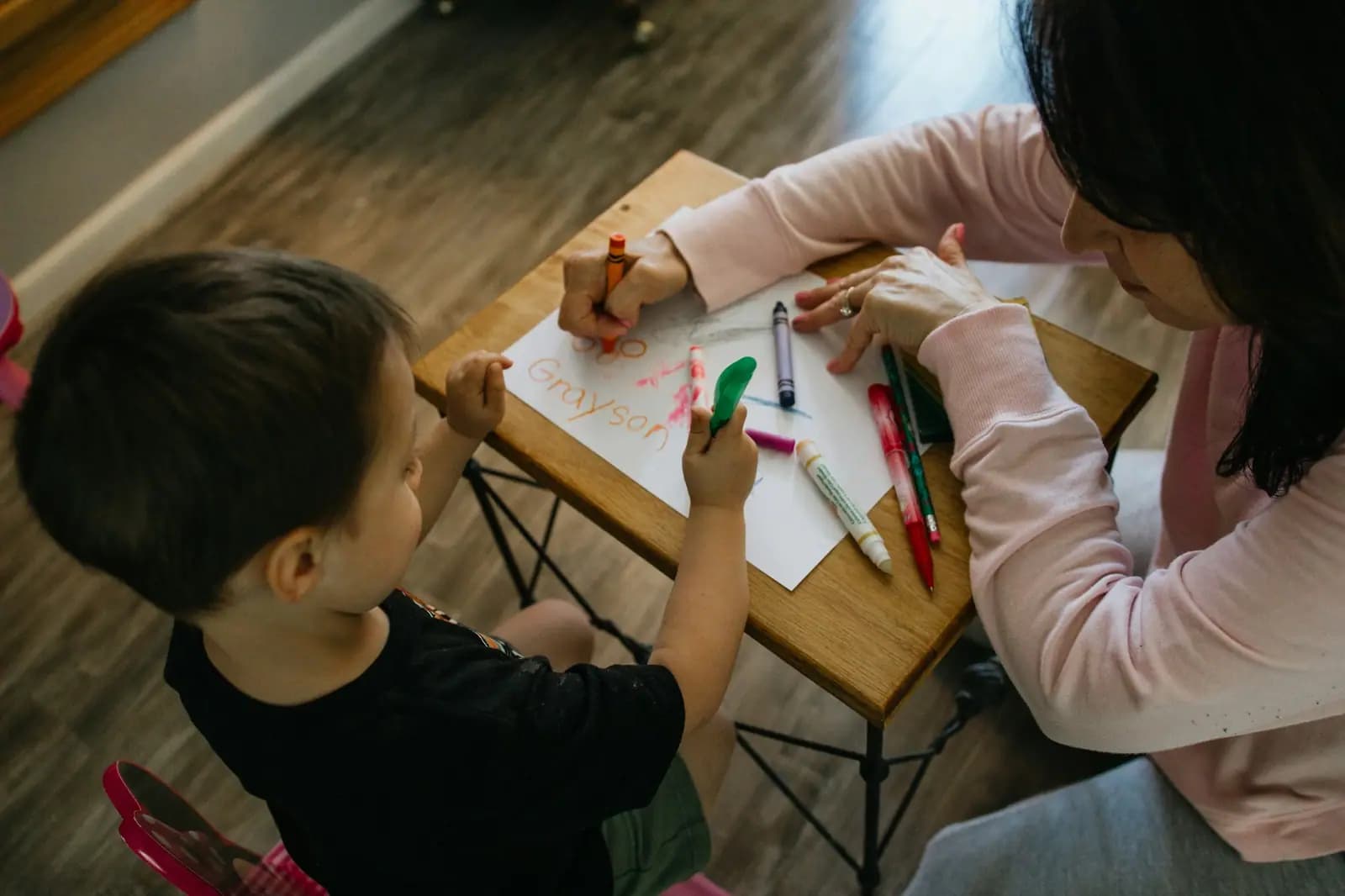
Plans and delivers structured learning. Supports homework, reading, numeracy and daily living skills. Follows the strategies set by the child's school, therapists or psychologist. Manages routines, transitions and sensory needs. Keeps a daily record and reports to you and to us.
They do not diagnose, treat, prescribe or deliver therapy. Where a child needs those, we help you find the right clinician and our educator works alongside them.
What's included
Structure the whole household can follow.

Small steps, the same way every day.
Structured learning
Planned sessions built on what your child can already do, one step at a time.
Homework and daily skills
Reading, numeracy, homework and the daily-living skills that make a morning work.
Routines and transitions
Visual schedules, prepared changes and sensory needs handled before they become hard.
A daily record
What happened today, written so the next therapy session starts from real information.
How it works
From brief to placement.
One point of contact from the first message to the ninety-day review.
- 01
A private conversation
You tell us about your child, your household and what a good year would look like.
- 02
The child-support profile
A special-needs specialist builds it with you, and with the school and clinicians if you wish.
- 03
A verified shortlist
Usually two or three candidates, each with a full file: qualifications confirmed, references spoken to, interviews passed.
- 04
Interviews and trial
You meet them, in person or on video. A paid trial period follows before anyone commits.
- 05
Terms in writing
Hours, days, fees, who engages whom, and what happens on holidays and sick days, all before the first day.
- 06
Supervision
First-week, thirty-day and ninety-day reviews, monthly reports, and a replacement guarantee.

Home
The whole household.
A child's day is usually held by more than two people. A good special educator does not replace them. They write the plan in a way everyone in the home can follow, show the household how the routines work, and keep the record that lets a therapist see what happened between sessions.
Part-time, after-school, holiday and temporary cover are all available. Fees are quoted on the brief.
A special educator is an educator. The moment a child needs a clinician, we say so.
Questions
Questions families ask
What does a special educator do at home?+
Plans and delivers structured learning. Supports homework, reading, numeracy and daily living skills. Follows the strategies set by the child's school, therapists or psychologist. Manages routines, transitions and sensory needs. Keeps a daily record and reports to you and to us.
Can they give my child therapy?+
No. Our special educators are educators. Speech therapy, occupational therapy, behaviour analysis, diagnosis and treatment are for separately qualified professionals. We coordinate with yours.
What hours?+
After-school blocks are most common. Morning blocks for children not yet in school, full days for children being home-schooled, and holiday cover are all arranged on the brief.
What if it does not work?+
A paid trial period comes first, then a replacement guarantee for the period stated in your agreement.
From the blog
Blogs on special educators at home



By city
Special educators in your city.
We are present in 55 cities across India. Choose yours for the neighbourhoods we cover, the schools we work with and the languages on offer.
- Special educators in Agra
- Special educators in Ahmedabad
- Special educators in Amritsar
- Special educators in Bengaluru
- Special educators in Bhopal
- Special educators in Bhubaneswar
- Special educators in Chandigarh
- Special educators in Chennai
- Special educators in Chhatrapati Sambhajinagar
- Special educators in Coimbatore
- Special educators in Dehradun
- Special educators in Delhi NCR
- Special educators in Dhanbad
- Special educators in Ghaziabad
- Special educators in Guwahati
- Special educators in Gwalior
- Special educators in Hubballi-Dharwad
- Special educators in Hyderabad
- Special educators in Indore
- Special educators in Jabalpur
- Special educators in Jaipur
- Special educators in Jamshedpur
- Special educators in Jodhpur
- Special educators in Kanpur
- Special educators in Kochi
- Special educators in Kolkata
- Special educators in Kota
- Special educators in Kozhikode
- Special educators in Lucknow
- Special educators in Ludhiana
- Special educators in Madurai
- Special educators in Mangaluru
- Special educators in Meerut
- Special educators in Mumbai
- Special educators in Mysuru
- Special educators in Nagpur
- Special educators in Nashik
- Special educators in Noida
- Special educators in Patna
- Special educators in Pimpri-Chinchwad
- Special educators in Prayagraj
- Special educators in Pune
- Special educators in Raipur
- Special educators in Rajkot
- Special educators in Ranchi
- Special educators in Solapur
- Special educators in Srinagar
- Special educators in Surat
- Special educators in Thane
- Special educators in Thiruvananthapuram
- Special educators in Tiruchirappalli
- Special educators in Vadodara
- Special educators in Varanasi
- Special educators in Vijayawada
- Special educators in Visakhapatnam
Explore
Other services

ABA therapy
Applied behaviour analysis designed and supervised by a BCBA, at home, at school, online or at a centre.
Find out more
Shadow teachers
One-to-one support inside the school day, placed only with the school's agreement.
Find out more
Remedial tutoring
Structured literacy and numeracy for dyslexia, dysgraphia and dyscalculia, at home or online.
Find out more
Start here
Tell us about your child.
A private conversation first. No fee, no obligation, and nothing is shared without your consent.
- 1A private conversation
- 2Your child-support profile
- 3A verified shortlist